Airports
2025Q4
Airports are an attractive sector for infrastructure debt investors with their monopoly characteristics and because their customers, the airlines, act as a buffer sheltering airport revenues from the impact of economic shocks. Air travel is a fundamentally cyclical industry. Shocks can vary from the usual fluctuations in demand as a result of the economic cycle to more substantial events such as September 11 and COVID. History has proven that, over time, passenger numbers eventually recover to the long run trend with Australian airports now back to pre-COVID level passenger movements.

One key trend we are watching is the rise of more efficient and often smaller aircraft that make longer thinner routes economically feasible. The newest range of passenger aircraft are more fuel efficient than their predecessors. This is making previously unprofitable routes, that were not dense enough, profitable. Airlines are expanding their network maps on longer thinner routes and carriers are reducing dependence on hubs.
New narrowbody aircraft like the A220, A321XLR and B737 Max are opening up new direct routes that were previously unprofitable. For example, Qantas is starting new international flights to smaller New Zealand cities such as Brisbane to Wellington and expanding routes such as Sydney to Christchurch on the A220.
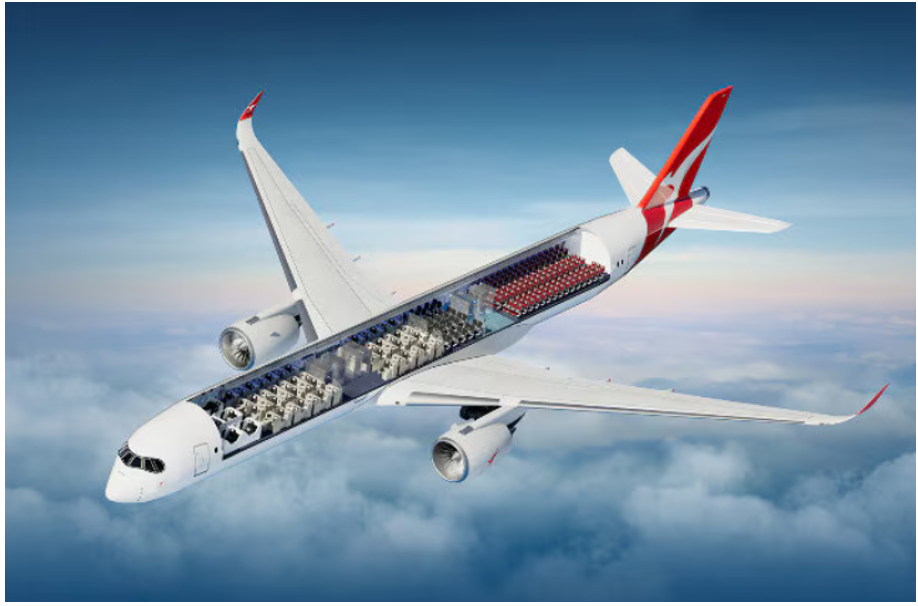
New wide body aircraft like the A350 and A777-9 are also opening up ultra long-haul routes without the need for a stopover. Qantas has ordered 12 A350-1000 as part of Project Sunrise and will start to offer direct non-stop flights between Sydney and London – a distance of 17,000 km and 22 hours of flight time. The current longest route is Singapore to New York on an A350 – 15,000 km and 19 hours flight time.
22 hours on a plane seems like torture in economy class, and you probably would want a stopover rather than sit in an economy class seat for that long. With this in mind, Qantas has configured the A350 with 140 economy seats, 40 premium economy, 52 business and 6 first class suites. From a physical space perspective only a third of the plane will be economy class seats!
In general, passengers prefer non-stop flights. As Canberrans having to transit through Sydney, Melbourne or Brisbane, this will reduce 3-5 hours from our international trips. The long-haul international flight back home is always a struggle arriving into an east coast city in the morning and having to transit to a domestic flight that you miss half the time.
These new aircraft appear to threaten the hub and spoke model of airports. Ultra long-haul flights will remove the need to stop in Singapore or Dubai on the way to Europe. The latest data shows international passengers at Adelaide, Brisbane, Carins, Darwin and Perth growing at significantly higher rates than Sydney and Melbourne.
Growth in revenue passenger movements for YE August 2025 compared to YE August 2024.

From an aircraft maintenance perspective, there are significant efficiency benefits to having a central hub to service all your aircraft and so we are unlikely to see dramatic movements away from airlines having a central hub. We are likely to see relatively higher growth at origin and destination airports compared to hub airports.